
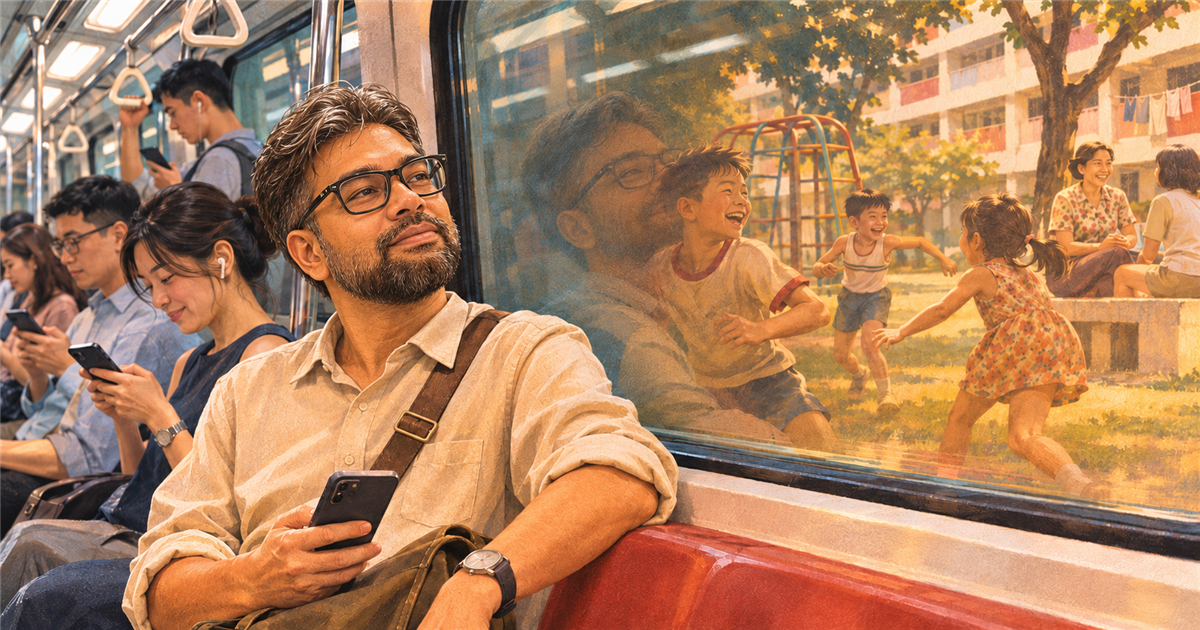
I have been reading articles and listening to podcasts in which people speak very highly about the practice of doing nothing. So I started thinking about it—while doing nothing, of course. Haha.
I was born in the 1970s. You don’t have to explain to me what doing nothing means. That was what we seemed to be doing 90 per cent of the time. It was not necessarily because we were lazy, wise or spiritually enlightened. We simply didn’t have much choice.
When entertainment was scarce
Going to the cinema was a rare occasion for me. Most of the movies I watched came from television broadcasts or rented VCR tapes. Sometimes, I wished television stations would show more movies. I also wished they wouldn’t stop broadcasting at midnight.
Even staying up that late was unusual. Sleeping at around 10pm was normal. Midnight television happened mainly because a movie was shown on Thursday or Friday night.
Imagine telling the younger version of me that one day, I would sit in front of a television with many of the world’s movies available at my fingertips. I could select one and begin watching immediately. There would be no need to wait for the scheduled broadcast time or arrange my life around the television guide. I could start whenever I was ready, with my snacks beside me.
And wait—there’s more.
I wouldn’t have to rush to the kitchen and back during a commercial break just to avoid missing part of the movie. I could pause it.
If someone had told me all this back then, I would have assumed I was dreaming.
Today, all of it is possible. We don’t even need to be sitting in front of a television in the living room. We can watch movies while standing in the middle of a crowded MRT train using a device that fits inside a pocket.
We have travelled from having almost nothing to watch to carrying practically unlimited entertainment everywhere. So perhaps now is a good time to revisit the lost art of doing nothing.
But first, let us stop romanticising the past.
We were not superior
People sometimes talk as though earlier generations spent time outdoors because we appreciated nature more. Children supposedly played outside because they were healthier, more imaginative and more sporting than children today.
I don’t necessarily believe that.
People generally do what they can do—and what makes the most sense with whatever is available at the time.
When I was young, books and the library were my friends. Other than that, there was homework, studying and more studying. At around 5pm, my brothers and I would go to the playground downstairs with our mother. She would sit and chat with her friends while waiting for my sister to be dismissed from school.
Nobody organised activities for us. There was no instructor, enrichment programme or planned learning outcome. We usually played catching.
If I told my mother I was bored, her standard response was:
“Go and play.”
And so we went and played.
But don’t give us too much credit. Place a PlayStation inside every household of the 1980s and then observe what those supposedly active and imaginative children do. My guess is that many of us would have remained indoors playing games too.
Then talk.
We were not necessarily more appreciative of the sky, flowers and playgrounds. Those were simply among the things available to us. Doing nothing was not a lifestyle movement. It was the default setting.
Five empty minutes must now be filled
Today, when I have five empty minutes while waiting for a train, I instinctively reach for my phone. I might continue reading an article from an app I subscribe to, or I might play a round of Clash Royale. Either way, those five minutes will be filled.
Sometimes, however, I deliberately delay taking out my phone. I perform what I call a head rotation.
I look at the trees, the pillars, the people and their faces. I observe how people dress and notice some of the current trends among younger people. Mainly, I see other heads looking down at screens.
There is some irony in that. When I finally look up from my screen, I discover everybody else looking down at theirs.
Does this worry me? Not really. I see it as the natural evolution of life.
Things have changed, but the common thread remains: people do what makes sense with what they have. Eventually, after looking around for a while, my mind says, “Okay, enough is enough. Let’s continue that article.”
And I take out my phone.
The answer is not another extreme
This is where many people get it wrong. We tend to swing from one extreme to another.
At one extreme, we allow devices to occupy every available second of our lives. At the other extreme, we blame phones for destroying civilisation and behave as though everyone should stare peacefully at trees for several hours.
I believe we need a finer balance.
Suppose a child follows his parents to a relative’s house. That was an especially effective boredom generator during my childhood.
Most of the people there were adults. They would greet us and make some small talk. Being a responsive child, I would do my best to participate. But how much can adults talk to a child? And how much can a child talk to adults?
Perhaps we could manage ten minutes. After that, what was I supposed to do during the remaining four hours while my parents remained deeply engaged in conversation? In the old days, I had no choice.
Today, I would suggest a balanced approach. Keep the device inside your pocket when you arrive. Greet everyone properly, respond to their questions and make a genuine effort to engage with them in the old-fashioned way.
After the initial conversation ends, wait another five minutes. Leave some space in case anyone wants to continue talking to you. Once you receive complete radio silence and the adults return to their own conversations, take out your phone. Read, watch something or play a game.
Before leaving, put the phone away again and spend another ten minutes saying goodbye properly.
This way, the adults feel that you spent time with them. They may also feel less guilty about forcing you to sit there doing nothing while they remain occupied with one another.
That, to me, is a sensible combination of the old and the new—the yin and yang of family visits.
Stop blaming the device
As an adult speaking to a child, I can tell when the child understands this balance. When I try to engage him, he puts his phone aside and responds. That is good enough for me.
If he refuses to put it down, perhaps I should also understand the message: he may be avoiding me.
But people gave avoidance signals in the past too. They looked elsewhere, gave one-word answers, found excuses to leave the room or buried themselves in a book. A phone may simply be the modern version.
The device did not invent avoidance. We should not blame technology for every old human behaviour that has found a new tool.
Please don’t give doing nothing a KPI
Here is another way people misunderstand the idea of doing nothing: modern life is so obsessed with productivity that we cannot even leave idleness alone.
Someone works sixteen hours a day. Then he reads that allowing the mind to wander can improve creativity and problem-solving. So he divides his sixteen-hour working day into four-hour blocks and inserts scheduled do-nothing sessions between them.
Then he waits for the output.
Did the session produce a new idea? Did it solve a business problem? Did productivity increase? Where is the KPI from doing nothing?
Come on.
Doing nothing is supposed to be doing nothing. Nothing is supposed to come out of it, and that should be the expectation. It should not be measured using a productivity tool.
Let the mind wander wherever it wants. Perhaps it will visit ideas, memories, solutions or self-reflection. Perhaps it will behave like a monkey, jumping from one unrelated thought to another. Let it.
Perhaps absolutely nothing useful will happen. Let that happen too.
When the session ends, do not complete an after-session review card. Do not record your insights, measure your creative output or rate the effectiveness of your idleness.
Just return to whatever you were doing.
Leave a little space unoccupied
I am not suggesting that we abandon technology and return to the 1970s. I enjoy having the world’s movies available at the touch of a button. I enjoy reading articles on my phone, and I enjoy playing games.
People of the past were not superior because they had fewer options. People today are not inferior because they use the options now available.
The goal is not to reject modern life. It is simply to leave a little space within it unoccupied.
Be present when someone is trying to engage you. Allow a few moments of silence before automatically reaching for a screen. Look around occasionally.
And sometimes, do nothing without demanding that the nothing improve you.
If an idea comes, let it come. If no idea comes, that is fine too.
Nothing happened.
That was the whole point.
Leave a Reply